By: Suzanne Jenkins
I'm going to make this short since my computer died last week and my old pc is giving me fits as well. I'll try to update this post when I get my good computer back. :)
I wasn't sure when I read the description for this book if I was going to like it or not, but I decided to give it a try. I'm glad that I did. The book was well written and the characters were "real", if you know what I mean. I haven't read the earlier books in this trilogy so I am having to play catch-up with the characters.
Pam is having to adjust to the difficult situation that she has found herself in following her husband's death. She is now paying for the consequences of his actions in so many ways. There are many who, in this same situation, would have reacted in the negative, would have raged against the world. Pam is gracious and kind to all of the people who come to her after his death. She also has to handle the sticky family situations regarding her sister's long term affair with Jack and telling her children that she is sick.
This book just pulled me in once I started it and I couldn't put it down until I was done. I am going to have to make some time to read the earlier books and discover how this story unfolds from the beginning.
FTC Notice: I received a copy of this book from the author.
Tuesday, September 11, 2012

Tuesday, August 28, 2012
Guest Post: Alicia Singleton - Holding On By Your Toenails When Your Dream Goes South
Did you have dreams when you were a child? What about now? What are your dreams? I want
to do back to school. Sticking my toes
in the blue waters of Bora Bora would be wonderful. I’ve always dreamed of owning a business. A home that’s mine is something I’ve always
wanted.
Well, you’re not alone. All of us have dreams. Some dreams happen quickly, some take time. All legitimate, passion-driven dreams deserve
to be pursued.
The years, 1995. The event, The Romance Writers of America
Conference. As I sat there, in the front
row at the editor’s panel session, feelings of excitement, contentment and
peace danced a jumbled mix in my stomach.
Throughout the conference, I’d asked questions about different
publishing houses and editor then scoped out the editor that I was going to
write for. After the session, I walked
up, waited my turn and pitched my novel.
She smiled and said, “Send it to me.”
Send it to me!!! I thanked her,
walked away cool, head held high.
Inside, my mind yelled, ‘Yeah, baby!’
I called home that night and told my
husband that I’d have a book contract in 6 months tops. Well, 6 months came and went. 6 more months, another year, five years then
ten, still no book contract.
What do you do when your dream seems to
go south? Don’t give up! Here’s what I suggest:
• Set your goals. Make a plan.
Work the plan. If the plan
doesn’t work, re-tweak the plan.
• Get a mentor, someone who is where you want
to be. Someone who is living your dream
and willing to share their expertise with
you.
• Surround yourself with level-headed, go-getter,
dreamers. (If you don’t take action to actively pursue your dream, you’re dead in
the water.)
• Stay connected to the related industry of
your dream. Attended conferences,
workshops, join professional organizations and network
with like-minded people. Some of the
people that I’ve met along the way have become my
closest friends.
• Your dream is yours. Do it for yourself. (If you’re pursuing your dream for someone
else, then is it your dream or an
obligation?)
•
When it gets hard, take a step back, take a deep breath then get back in the
game.
• Say positive affirmations. One of my favorites is: I refuse to accept the possibility of the death of my dreams.
What happened to your dream of becoming
an author with a major publishing house, you ask? Well, that dream came to fruition17 years
later.
I’m not going to lie and say waiting for
that day was giggles and roses. Some
days were so tough that I wanted to give up.
Being strong for the people that believed in me wasn’t always easy
either. Outside, I was the constant optimist,
but on many days my mind was screaming, ‘What
the hell!’ Then, I’d think about not
accomplishing what I’d set out to do, all of the time and effort I’d put into
bringing the dream to reality and letting down those people who had faith in
the dream, then I’d exit my pity party and get back to work.
The only way you will see your dreams
come true is if you never give up on them.
You might think that 17 years is a long time. A lifetime of regrets is even longer. Don’t quit.
Your dream is waiting!

About the Author:
Born and raised in Philadelphia, the Howard University graduate embraced the
written word at an early age. She credits this to her loving, older sister
whom, while they were youngsters, made the author eat lotion on a regular
basis. Realizing the need to sound-out the ingredients on the lotion label,
Alicia stopped the lotion-eating practice, but continued to read the labels of
the concoctions her sister brought for her to try. This early necessity to read
flowered to a passion; hence, a writer was born.The award winning author
resides in Maryland with her wonderful husband and son. Still an avid
reader, label or otherwise, Alicia is hard at work completing her next suspense
novel.Her latest book is the suspense novel, Dark
Side of Valor.Visit Alicia’s website at www.aliciasingleton.com.

Child advocate Lelia Freeman saves children for a
living. As the director of ChildSafe Shelters, she ventures to abandoned squats
and crackhouses to rescue teens from the hellish streets of Los Angeles. When
she is summoned to Washington to serve on a committee that aids the children of
a war-torn African nation, Lelia is kidnapped and becomes a political pawn in a
sinister conspiracy. Oceans away from everything she knows, she must trust a
mercenary to save her life, or die in the clutches of a psychopath.
Hunting, combat and staying alive are Elijah
Dune’s specialties. Vengeance is his passion. Haunted by past demons, he’s
travels to the Motherland to collect a debt. A debt that demands one payment.
Death.
Caught in the crosshairs of a madman, Lelia and
Elijah must survive the jungles of Zaire and the horrors of their pasts or be
forever consumed by the DARK SIDE OF VALOR.
Rafflecopter Code for the $100 Visa Giveaway:
a Rafflecopter giveaway
Friday, August 10, 2012
Guest Post: Wayne Zurl - Putting a Dialect into Dialogue
Writing dialogue with a dialect can generate controversy and debate, and on occasion, even animosity among writers and readers.
I write about a former New York detective working as a police chief in rural east Tennessee. The accents he’s been exposed to are about as similar as a Venezuelan and a Glaswegian both attempting to speak understandable English. Sorry, Scotland.
I live in the same area where my protagonist works. Coincidently, I’m also an ex-New Yorker. And through thirteen novelettes and two full-length traditionally published novels, I’ve used, in varying degrees, east Tennessee accents.
To my ear, there are three separate and distinct accents in and around the Great Smoky Mountains and I write them all. And occasionally I have a “Nu Yawkah” visit Chief Sam Jenkins and we hear them ask for a “cuppa kawfee” or tell him to “open a windah” or cut the grass with a “mowah.” I do that so the residents of southern Appalachia can’t accuse me of picking on them exclusively when some of my characters use the universal greeting of the region, “You doin’ aw rot t’day?” or any of the other appropriate colloquialisms I hear all the time.
Honest folks, I don’t make this up. I only write what I hear—and I have always had a good ear for languages. That’s why I can speak English fairly well, am semi-fluent in two other languages, and can swear and order a beer in five more.
Okay, let’s look at what the experts say. In his book THE 38 MOST COMMON FICTION WRITING MISTAKES (And How to Avoid Them), Jack M. Bickham wrote a 2 ¼ page chapter called Don’t Mangle Characters’ Speech. Jack says NEVER deviate from the King’s English; it may tend to confuse a reader. Prior to his death, Bickham published about 75 novels and taught English at the University of Oklahoma.
Since I didn’t like Jack’s answer, I looked further. Everyone’s heard of Stephen King and may have read one or more of his sci-fi/horror novels. I think we’ll all agree Stephen has done well for himself in the publishing business. I’m not a fan of horror stories, so I don’t read his fiction, but I liked and recommend his book ON WRITING (A Memoir of the Craft). The first half tells the story of a young Stephen King teaching high school English in Bangor, Maine, near poverty, and in danger of having his utilities turned off before he finally sold the famous CAREY. The second half is pure advice on how to write fiction King’s way.
Stephen’s take on writing dialect is, “Write it the way you hear it.”
And he’s got a unique accent to duplicate in “Down East” Maine.
Steve, however, goes on to say, “Don’t substitute apostrophes for the letters you leave out of the words.”
Example: writin’ rather than writing, should simply be writin, according to King.
So, I was looking at a stalemate, one for and one ag’in.
While working on my first full-length novel, A NEW PROSPECT, I hired Bill Greenleaf, a retired editor, book doctor, and author of nine novels.
Bill agreed with King and said, “Write it as you hear it; it’s more authentic when dealing with characters who speak with a unique accent.”
He further stated that new writers probably shouldn’t just omit letters without using the substitute apostrophe as suggested by King. That may only confuse editors, thinking you may be submitting a manuscript with typos.
Sad but true—a guy like Stephen King can get away with much more than you or I.
A NEW PROSPECT was published and the publisher/editor accepted all the dialect without question.
Since I’ve mentioned that book twice and at my age, I no longer have any modesty, I’ll tell you it was named best mystery at the 2011 Indie Book Awards. It is currently a finalist at the 2012 Eric Hoffer Book Awards and has been nominated for a Montaigne Medal. So, I guess the dialect hasn’t been too troubling to the judges who read the review copies.

Additionally, both the publisher and editor at Mind Wings Audio where they’ve produced my novelettes as audio books and simultaneously published them as eBooks have accepted everythbing written with oodles of Tennessee dialect. The actor who reads the text says he has fun shifting voices. (A novelette is defined as something between 7,500 and 17,500 words.)
Some readers or reviewers of my works say, “I’m from the south and I don’t speak like that.”
Understandable. Someone from Charleston, South Carolina or Paducah, Kentucky sounds nothing like someone from Cocke County, Tennessee. Someone from Nashville in middle Tennessee doesn’t remotely sound like someone from the Smokies.
To these complainers I say, “If you’ve never been in my neck of the woods, don’t comment on how my neighbors speak.” Not only can I state with authority how a resident of east Tennessee sounds (I’ve been here for twenty years) but I lived in New York for forty-six years and know first-hand someone from Brooklyn speaks nothing like a resident of Buffalo and both possess distinct accents.
Recently, a reviewer said, “Writing in dialect never works.”
I’m suspicious of someone who uses absolutes like always or never. When I hear that, I tend to wonder where they derive their expertise on the subject upon which they commented.
This reviewer claimed, “It would be enough to state that the character spoke with a heavy accent.”
Isn’t that telling and not showing? Just the opposite of what good writers are supposed to do.
George Peleconos has written a successful series of novels featuring Derek Strange, an African American private detective working in Washington DC. Peleconos extensively writes dialogue in Ebonics. And it only makes sense. The jive-ass, hip-hop, gangsta-rapping, young drug dealers Derek encounters during his adventures do not speak like little old men from Cedar Rapids, Iowa. In my opinion, it would not sound authentic and it would detract from the story if he omitted the dialect.
And I should mention an old book with lots of dialect and a pretty fair track record: THE ADVENTURES OF HUCKLEBERRY FINN by a guy who called himself Mark Twain.
Some readers have told me, “Reading dialects makes me slow down.”
So what? What’s the hurry? Do you want to absorb and understand a novel or just knock out another book and add one more to your “I’ve read” list?
Shifting from one writer’s voice to another causes me to slow down until I pick up the cadence and get in tune with a different style. In only a few pages most readers should clique with something new.
Sometimes, I think semi-professional readers (self-styled, unpaid reviewers) cruise through books so fast they really can’t write an honest or intelligent review.
Another opinion (mine), “Everyone should savor a good book. Slow down and smell the printer’s ink.”


Amazon link: http://amazon.com/author/waynezurl
B&N link: http://barnesandnoble.com/s/wayne-zurl
Mind Wings Audio link: http://mindwingsaudio.com/?s=wayne+zurl
.
Review: A Leprechaun's Lament

A Leprechaun's Lament by Wayne Zurl
My rating: 4 of 5 stars
This is the first book that I have read in the Sam Jenkins Mysteries and I really enjoyed it. The characters were believable and entertaining. I enjoyed getting to know that members of the Prospect PD and the people of Prospect, TN.
The story begins with Chief Sam Jenkins, and members of his staff, doing background checks on the city's employees who interact with the police department. Once he starts looking into them, he starts to find that things don't add up with one particular employee, Murray McGuire. Soon after, McGuire is found dead. Now, Chief Jenkins needs to find out why McGuire was killed and what secrets he was hiding when he died.
The book was well written and I look forward to reading more of the Same Jenkins books as well as other books by Wayne Zurl.
FTC Notice: I obtained a copy of this book from the author.
View all my reviews
Thursday, July 26, 2012
Guest Post: Suzanne Jenkins - This Makes Me Uncomfortable
As I began writing in earnest two years ago, the inspiration to tell a story about an older woman who discovered her beloved husband’s infidelity after he died came from out of nowhere. Pam of Babylon simply appeared in my consciousness and I wrote it as I thought of it. Later, a quote by E.L. Doctorow would confirm my writing style was not unusual. He said, “Writing is like driving a car in the dark. You only see as far as the headlights go, but you can make the whole trip that way.” Those words validated me. An encounter with an editor who did not like my story line made me doubt the wisdom of spending another second writing. She asked me to do an outline before I began to write, which I found nearly impossible to do because of the way the book was coming to me as I went along. She referred to the story as triple-x rated because it contained a depiction of child abuse. Child abuse transcends the rating system.
Later, I learned from a fellow author that sometimes a writer/editor relationship may not be a good fit and it is acceptable to move elsewhere. Once I found the courage to move on, I found a new editor. She was a barracuda who demanded revisions and rewrites, but she also loved the story and wanted it to be the best I could make it. I felt totally comfortable deferring to all of her suggestions and to this day wish I had used her from the onset. However, once the story was published, I would encounter readers who felt the same way my former editor did. My books are not for everyone. I can’t say I enjoy writing about topics that many people find repugnant and some that are downright disgusting like the child abuse and marital infidelity. But it’s something that I find compelling for whatever reason and the stories wind through the tragedy and horror that normal people sometimes encounter.
After a book is finished, I suffer from insomnia for months. I’m in that mode right now. The Greeks of Beaubien Street will be released this summer, and although I love the story, there is a portion of the book that worries me because it depicts the seamier side of life in a most grotesque way. Even the perpetrator is disgusted with the crime. I know there will be those readers who are offended by it in spite of a warning. I almost didn’t write the book until my son, a filmmaker and writer told me not to censor myself. I have tried censoring in the past and once I began, I found I was putting up so many parameters I could no longer write. The question I had to ask myself over and over confirmed that the story line was important. What is my purpose in writing about this topic? It isn’t to titillate, or to be sensational. In The Greeks, the horror story is in contrast to the gentle Greek father who prepares his homicide detective daughter’s breakfast every morning.
Regarding Pam of Babylon’s adult content, I tried to write so that it would be the least offensive as possible. If a writer is going to have child abuse as a topic, there is little that can be done to clean it up. It’s deplorable, and the consequences are usually tragic. The Kirkus Review said about the third book in the series, Dream Lover; “A gritty, realistic portrait of the aftermath of deceit.” In order for the resolutions to take place, I must first describe the conflict.
My friend Dan Georgakas, author of My Detroit, Growing up Greek and American in Motor City (Pella Publishing Company, NY, NY, 2006) wrote when I confided my concerns, “….people are embarrassed by this [content] and want to project a perfect family image: a stereotype no one is going to believe anyway. I have always believed in showing warts whenever possible.” Some of character’s warts are painful to look at, but exist in real life.
The final book in the series may be finished this fall and has some of the characters achieving positive resolutions. Fans of Pam will be relieved that she is triumphant in the end.
 About the Author
Suzanne Jenkins lives at the west Michigan lakeshore with her husband, two dogs and two sheep. Her latest books are Pam of Babylon, Don’t You Forget About Me and Dream Lover.
 About Pam of Babylon:
Pam Smith lives a charmed life as a well-to-do Babylon, N.Y., homemaker in a large house by the water. In her 50s with her children grown, Pam is happy with her exemplary husband Jack. After he has a heart attack on the subway, however, she finds out more than she ever wanted to know about Jack. Pam must confront a series of revelations that unmask a life she realizes she only thought she knew, and the losses and disappointments she discovers give color and understanding to a man markedly different than he appeared. Uncovering secrets and betrayals far worse than her most vivid nightmare, Pam retreats to their meticulous Babylon beach house, the one refuge she has to put the pieces of her life together and move toward ultimate forgiveness.
Later, I learned from a fellow author that sometimes a writer/editor relationship may not be a good fit and it is acceptable to move elsewhere. Once I found the courage to move on, I found a new editor. She was a barracuda who demanded revisions and rewrites, but she also loved the story and wanted it to be the best I could make it. I felt totally comfortable deferring to all of her suggestions and to this day wish I had used her from the onset. However, once the story was published, I would encounter readers who felt the same way my former editor did. My books are not for everyone. I can’t say I enjoy writing about topics that many people find repugnant and some that are downright disgusting like the child abuse and marital infidelity. But it’s something that I find compelling for whatever reason and the stories wind through the tragedy and horror that normal people sometimes encounter.
After a book is finished, I suffer from insomnia for months. I’m in that mode right now. The Greeks of Beaubien Street will be released this summer, and although I love the story, there is a portion of the book that worries me because it depicts the seamier side of life in a most grotesque way. Even the perpetrator is disgusted with the crime. I know there will be those readers who are offended by it in spite of a warning. I almost didn’t write the book until my son, a filmmaker and writer told me not to censor myself. I have tried censoring in the past and once I began, I found I was putting up so many parameters I could no longer write. The question I had to ask myself over and over confirmed that the story line was important. What is my purpose in writing about this topic? It isn’t to titillate, or to be sensational. In The Greeks, the horror story is in contrast to the gentle Greek father who prepares his homicide detective daughter’s breakfast every morning.
Regarding Pam of Babylon’s adult content, I tried to write so that it would be the least offensive as possible. If a writer is going to have child abuse as a topic, there is little that can be done to clean it up. It’s deplorable, and the consequences are usually tragic. The Kirkus Review said about the third book in the series, Dream Lover; “A gritty, realistic portrait of the aftermath of deceit.” In order for the resolutions to take place, I must first describe the conflict.
My friend Dan Georgakas, author of My Detroit, Growing up Greek and American in Motor City (Pella Publishing Company, NY, NY, 2006) wrote when I confided my concerns, “….people are embarrassed by this [content] and want to project a perfect family image: a stereotype no one is going to believe anyway. I have always believed in showing warts whenever possible.” Some of character’s warts are painful to look at, but exist in real life.
The final book in the series may be finished this fall and has some of the characters achieving positive resolutions. Fans of Pam will be relieved that she is triumphant in the end.

Suzanne Jenkins lives at the west Michigan lakeshore with her husband, two dogs and two sheep. Her latest books are Pam of Babylon, Don’t You Forget About Me and Dream Lover.
- To get your copy of PAM OF BABYLON by Suzanne Jenkins at Amazon: http://www.amazon.com/Pam-Babylon-Suzanne-Jenkins/dp/1461135923/ref=sr_1_1?s=books&ie=UTF8&qid=1310645577&sr=1-1
- To get your copy of DON’T YOU FORGET ABOUT ME by Suzanne Jenkins at Amazon: http://www.amazon.com/Dont-Forget-About-Book-Babylon/dp/1466219009/ref=pd_sim_b_2
- To get your copy of DREAM LOVER by Suzanne Jenkins at Amazon:
- http://www.amazon.com/Dream-Lover-Book-Three-Babylon/dp/1468126237/ref=pd_sim_b_1
- Pick up your copy of PAM OF BABYLON by Suzanne Jenkins at Barnes & Noble: http://www.barnesandnoble.com/w/pam-of-babylon-suzanne-jenkins/1104205831?ean=2940013633056
- Pick up your copy of DON’T YOU FORGET ABOUT ME by Suzanne Jenkins at Barnes & Noble: http://www.barnesandnoble.com/w/dont-you-forget-about-me-suzanne-jenkins/1108113721?ean=2940014047722
- To learn more about Suzanne Jenkins, visit her website: http://suzannejenkins.net/
- Drop in at Suzanne Jenkins’ blog: http://2sheepinthecity.com
- Visit Suzanne Jenkins on Twitter: https://twitter.com/#!/suzannejenkins3
- Like Suzanne Jenkins on Facebook: https://www.facebook.com/suzannejenkinswriter

Pam Smith lives a charmed life as a well-to-do Babylon, N.Y., homemaker in a large house by the water. In her 50s with her children grown, Pam is happy with her exemplary husband Jack. After he has a heart attack on the subway, however, she finds out more than she ever wanted to know about Jack. Pam must confront a series of revelations that unmask a life she realizes she only thought she knew, and the losses and disappointments she discovers give color and understanding to a man markedly different than he appeared. Uncovering secrets and betrayals far worse than her most vivid nightmare, Pam retreats to their meticulous Babylon beach house, the one refuge she has to put the pieces of her life together and move toward ultimate forgiveness.
Monday, July 23, 2012
Guest Post: Kevin Burk - Mind Your Own Business
Byron Katie is an author
and speaker who created a powerful process called “The Work.” In her first
book, Loving What Is, Katie suggests that there are three types of
business in the world: “My Business,” “Your Business” (“Other People’s
Business”), and God’s Business. She points out that anytime you find yourself
in “Other People’s Business” or “God’s Business,” you feel stressed. Why?
Because you don’t have any business in “Other People’s Business” or “God’s
Business.” When you’re in “Other People’s Business,” or “God’s Business,” you
have no control and no influence. In fact, when you’re in “Other People’s
Business” or “God’s Business,” you are powerless.[1]

In the astrology world, he is best known for making Classical Astrology accessible to everyone, taking complex and abstract concepts and showing how they can be used to create concrete, specific and practical interpretations. Kevin’s website, The Real Astrology with Kevin B. Burk is one of the premiere astrology resources on the Internet. His book, Astrology: Understanding the Birth Chart is a textbook used at Kepler University in their Undergraduate Astrology Degree program, and has been translated into Russian, and is currently being translated into Bulgarian. Kevin’s articles have appeared in The Mountain Astrologer, the Australian publication,Well Being Astrology, and in Llewellyn’s Moon Sign books.
In the non-astrology world, Kevin is best known for his unique approach to understanding and improving all human relationships through The Relationship Handbook andThe Relationship Workshops.
Kevin has released a series of DVDs of his Law of Attraction workshops: the self-contained Prosperity & The Law of Attraction, and Astrology & The Law of Attraction, a series of 7 DVDs recorded live inHouston , TX
Kevin has developed a revolutionary program for spiritual growth called Archetypal Astrology: The Hero’s Journey. This intensive program guides participants through the process of meeting and moving into Right Relationship with each of the seven Astrological Archetypes (you may know them as the seven personal planets).
Kevin is currently synthesizing astrology and spirituality into his next series of books: Astrology & The Law of Attraction, Prosperity & The Law of Attraction andRelationships & The Law of Attraction.
You can visit Kevin’s website at www.GetAngryGetHappy.com.
To get your paperback copy of ANGER MASTERY by Kevin Burk: http://www.amazon.com/Anger-Mastery-Kevin-B-Burk/dp/0975968238
To purchase a copy of ANGER MASTERY at Barnes & Noble: http://www.barnesandnoble.com/w/anger-mastery-kevin-b-burk/1104012568
Buy the book directly from the author at www.GetAngryGetHappy.com
Like Kevin Burk on Facebook: https://www.facebook.com/AngerMastery

ABOUT ANGER MASTERY

Put another way, when
you’re in “Other People’s Business,” or “God’s Business,” you’re in Victim
Consciousness, so any action you take will only make things worse.
You may find it
difficult to grasp the difference between “My Business,” and “Other People’s
Business,” so here’s some helpful advice. If you can’t seem to find the line
that divides “My Business” from “Other People’s Business,” look behind you.
Anytime you find
yourself feeling angry or stressed, chances are, you’re in Victim
Consciousness. All you have to do in order to step back into integrity is ask
yourself, “Whose business is it?”
Now, I like to think
that I can spot an idea for a good game show a mile away. I did, in fact, have
a chance to pitch my idea for Whose Business Is It? to Howie Mandel’s
people at NBC Universal. Unfortunately, they said “No deal.” I remained
undaunted by their obvious lack of vision (after all, these are the same people
who, all evidence to the contrary, still believe that “America’s Got Talent”),
and filmed an episode anyway. You can watch it online at www.GetAngryGetHappy.com. Meanwhile, I’ll teach
you how to play the home version.
In order for something
to be “My Business,” it has to meet three criteria:
1. It must affect you,
personally, right now.
2. It must be your
responsibility.
3. You must be able to
do something about it.
Unless a situation meets
all three criteria, it is none of your business.
Remember, just because you’re involved in something doesn’t mean it’s any
of your business!
Most people get hung up
on #3, so let me take a moment to elaborate. Your being able to do something
about a situation means that you are able to adjust, change, modify or alter
the circumstances in some way. Note that if changing, adjusting, modifying or
altering the circumstances requires that you get other people to change their
behavior, you’re wasting your time. There is nothing you can do to get anyone
else to behave the way you would like them to behave. (If you don’t believe me,
ask my father.) If you can accept that you have no power to change anyone
else’s behavior, you’ll save yourself a tremendous amount of suffering, and
significantly reduce the amount of time you spend in Victim Consciousness.
When you discover that
you’re involved in a situation that is not your business, stop, take a step
back, say, “This situation is none of my business,” and then drop it.
For example:
“The economy is none of
my business.”
“The government is none
of my business.”
“Other people’s
marriages are none of my business.”
“What my mother thinks
of me is none of my business.”
When you drop the story
and step back into “My Business,” you’ll no longer feel angry; however, you
will still have all of the energy of your anger available to you. It’s
important that you use this energy yourself—otherwise, other people will steal
it from you.
Take this extra energy
and work it off at the gym. Use it to clean your garage, do your taxes, or
remodel your kitchen. Whatever you do, don’t take any action that
has anything at all to do with the story that was making you angry. The more you practice this, the more comfortable you will become
using your own energy. In time, you’ll be able to store this extra energy and
use it to become truly, completely happy. This is the first step towards
mastering your anger.

About the Author:
Kevin B. Burk has been helping people around the world to
improve their lives and relationships since 1996 through his astrological
counseling and relationship coaching practice. His humor, wisdom and compassion
are always present, in his books (ten so far, including Astrology: Understanding
the Birth Chart, The Relationship Handbook: How to Understand and Improve Every
Relationship in Your Life, and his newest book, Anger Mastery: Get Angry, Get
Happy), his classes and workshops, and his interactions with his clients and
students. Kevin’s focus is always on the practical, exploring how we can
actually use astrology and spiritual practice on a daily basis to transform our
lives.In the astrology world, he is best known for making Classical Astrology accessible to everyone, taking complex and abstract concepts and showing how they can be used to create concrete, specific and practical interpretations. Kevin’s website, The Real Astrology with Kevin B. Burk is one of the premiere astrology resources on the Internet. His book, Astrology: Understanding the Birth Chart is a textbook used at Kepler University in their Undergraduate Astrology Degree program, and has been translated into Russian, and is currently being translated into Bulgarian. Kevin’s articles have appeared in The Mountain Astrologer, the Australian publication,Well Being Astrology, and in Llewellyn’s Moon Sign books.
In the non-astrology world, Kevin is best known for his unique approach to understanding and improving all human relationships through The Relationship Handbook andThe Relationship Workshops.
Kevin has released a series of DVDs of his Law of Attraction workshops: the self-contained Prosperity & The Law of Attraction, and Astrology & The Law of Attraction, a series of 7 DVDs recorded live in
Kevin has developed a revolutionary program for spiritual growth called Archetypal Astrology: The Hero’s Journey. This intensive program guides participants through the process of meeting and moving into Right Relationship with each of the seven Astrological Archetypes (you may know them as the seven personal planets).
Kevin is currently synthesizing astrology and spirituality into his next series of books: Astrology & The Law of Attraction, Prosperity & The Law of Attraction andRelationships & The Law of Attraction.
You can visit Kevin’s website at www.GetAngryGetHappy.com.
To get your paperback copy of ANGER MASTERY by Kevin Burk: http://www.amazon.com/Anger-Mastery-Kevin-B-Burk/dp/0975968238
To purchase a copy of ANGER MASTERY at Barnes & Noble: http://www.barnesandnoble.com/w/anger-mastery-kevin-b-burk/1104012568
Buy the book directly from the author at www.GetAngryGetHappy.com
Like Kevin Burk on Facebook: https://www.facebook.com/AngerMastery

ABOUT ANGER MASTERY
Author Kevin B. Burk wants to make you angry.
Burk believes that getting angry is the first step to happiness, and his newest
book, Anger Mastery: Get Angry, Get Happy shows you how.
“Anger is like fire,” says Burk. “When you master
it, it’s a powerful source of energy. If you don’t master it, however, it can
be dangerous and destructive.” More importantly, Burk asserts, until you master
your anger, other people will steal your energy, your power, and your ability
to be happy.
The Anger Mastery Process has three phases. In
Phase 1, you learn how to use more of your own energy, which makes it harder
for other people to steal it from you. (This involves going to the gym at least
five times a week.) You also learn how to leave Victim Consciousness and move
into integrity by answering the question, “Whose business is it?”
Phase 2 of the Anger Mastery process helps you to
stay out of Victim Consciousness by learning how to feel Safe. You meet your
Safety Needs with a tool called the Present Moment Awareness Safety Meditation,
available for free at www.GetAngryGetHappy.com.
By the time you complete Phase 2, you will
already notice significant changes in your life. In particular, you will have
considerably more energy. Phase 3 shows you how to use that energy to become
truly, completely happy.
Anger Mastery is not your typical book on anger.
Not only is Burk’s approach unique, but also the book itself is laugh-out-loud
funny. “Humor is a powerful tool to shift consciousness,” said Burk. “Laughter
instantly transforms anger. Plus, funny sells more books.”
______________________________~ ~ ~ NOOK 8GB TABLET GIVEAWAY ~ ~ ~
Pump Up Your Book and Kevin Burk are teaming up to give you a chance to win a Nook 8GB Tablet!
Enter to win!!!!
a Rafflecopter giveaway
[1] Byron Katie, Loving What Is:
Four Questions that Can Change Your Life (New York ” Harmony Books, 2002), 3.
Tuesday, June 12, 2012
Guest Post: Linda Schroeder - Legos And Words: Four Comparisons For Writers
Take
your kids to Disneyland and they will ride things that scare you or keep you
singing It’s A Small World After All for the rest of the week. Take your kids
to Legoland and you can learn what writing is all about.
Now
I admit that is an odd thing to say. But I recently spent the day with my
granddaughter at Legoland. It is not such a hectic place as Disneyland so I had
time to wonder who thought to build it. And that led me to wonder why we
writers build stories. I’m a firm believer that you can, indeed, compare apples
and oranges. So I stand by the following four comparisons between Legos and
writing.
1.
Both Lego builders and writers deal in illusions. Both try to shape something
that viewers think is real. Is that elephant real? Is Hamlet real? It’s all in
the details. If you are precise, detailing what things look, feel, taste,
sound, or smell like, readers will believe you just as kids believe the
elephant at Legoland is real. In Artists
& Thieves I created a “sensory overload” scene in a jazz club in
Cannery Row with a lot of vivid colors, sounds, tastes, and emotions for the
characters. I had real singers perform, but all else was fiction. Readers tell
me they looked for the club but couldn’t find it.
2.
Both build elaborate structures with little interlocking pieces. Legos come in
two basic shapes, rectangles and squares. But some are bigger than others. And
some are cylinders. From these limited shapes, very patient people construct
tiny cars and two inch people. They build a life-size Darth Vader and a Volvo.
They also build replicas of cities like New York and Las Vegas, huge long units
that form skylines about as tall as adult visitors. It helps that their fingers
are flexible.
Writers
build with words, some are tiny, some long, some are loaded with hidden
meanings, some crystal clear. There are at least three quarters of a million of
them in English. That’s a lot of construction blocks. It is the writer’s job to
interlock them into sentences, fit them together to build small haiku poems or
long novels. It helps if the writer’s brain is flexible. It helps if the words
are chosen carefully: a character who simply walks down stairs is not as vivid
as one whose too large shoes slap loudly on the steps; a character who
“ponders” which way to go when fleeing a killer doesn’t seem credible.
3.
Legos come in bright and neutral colors. The variety helps distinguish parts.
So does variety in sentence structure. Write only with single syllable words?
Not so interesting. Write only noun-plus-verb sentences? Boring. Dialogue adds
color. When my character Hunter searched the heroine’s room for a stolen bowl,
I didn’t tell the reader he knew she was a liar but the dialogue conveyed it:
Give
up,” she said. “That bowl is on its way to China.”
“And
you are Snow White,” Hunter said.
4.
One last comparison. Breaks. Benches.
Shade. Iced drinks. We need to rest in the midst of activity. We also need to
catch our breath in the midst of a tense story. Give the reader some ice tea
like an easy description or incidental dialogue between secondary characters.
One reason some people read the end of a story first is so they won’t have to
worry all the way through about what is going to happen to the hero. So be kind
to the reader and provide some rest stops along the way.
 ABOUT LINDA SCHROEDER
Linda Schroeder divides her time between the bright sun of California and the high mountains of Colorado. She has a Master’s degree in English and one in Communicative Disorders/Audiology. In addition to her novel, Artists & Thieves, she has published a college text.
Her early interest in English expanded to include language disorders and she began a second career as an audiologist and aural rehabilitation therapist working with deaf and hard-of-hearing children and adults.
Currently, she studies and practices Chinese brush painting, celebrating the vitality and energy of nature. She follows art and art theft blogs and writes her own blog about art and sometimes includes reviews of novels. She is working on two more novels, a second Mai Ling novel about the Diamond Sutra, and a Sammy Chan art mystery about the forgery of a Goya painting.
You can visit her website at www.artistsandthieves.com.

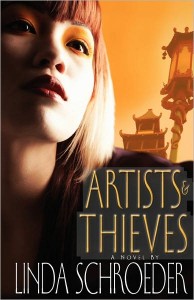 ABOUT ARTISTS AND THIEVES
Winner of the 2011 San Diego Book Awards, Action/Suspense category
Where there is art, there are thieves.
Mai Ling is both. Artist by day, thief by night, she recovers stolen art for Interpol. It’s a business, not a passion, until her beloved grandfather reveals a family secret that is also a destiny. He is duty-bound to return to China an especially precious bowl which belonged to his ancestor. Mai must steal it for him.
But Mai Ling is not the only one after the bowl. Four others plan to extract the bowl from a private California art collection. The rival thieves grasp and then lose the bowl until finally Mai is faced with the ultimate dilemma: save the bowl or save herself. Her duty to her grandfather gives her only one choice.
Set against the vibrant backdrop of the Monterey Peninsula and peopled with quirky characters, this stylish art caper entertains on every page.
Amazon
Barnes & Noble

WATCH THE TRAILER
~ ~ ~ KINDLE FIRE GIVEAWAY ~ ~ ~
Pump Up Your Book and Linda Schroeder are teaming up to give you a chance to win a Kindle Fire!

ENTER TO WIN!
a Rafflecopter giveaway
Subscribe to:
Posts (Atom)